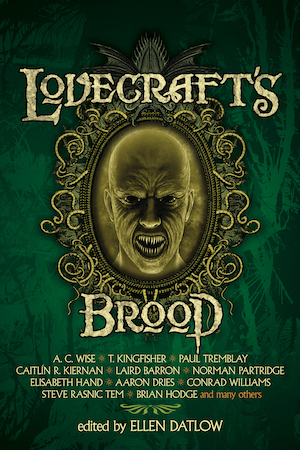
Lovecraft’s Brood
Lovecraft’s Brood, published by Tachyon, is a compilation of nineteen previously published stories. Some of the tales conform closely to the Lovecraftian paradigm, while others seem more of a stretch. In the book’s introduction, esteemed editor Ellen Datlow elucidates on what constitutes a Lovecraft archetype: “Where cosmic horror most deftly defines itself in its portrayal of the self versus the overwhelming odds of a cosmic force.” The five narratives in the anthology that most appealed to me fall into that standard, with a little leeway involved in interpretation. Each has its own merits.
Certainly, “Mister Ainsley,” written by Steve Rasnic Tem, is unequivocally Lovecraftian. Its original 2017 publication was courtesy of PS Publishing, in Black Wings VI: New Tales of Lovecraftian Horror edited by S.T. Joshi. The story’s eponymous protagonist lives alone, after his wife’s passing. He has no desire to interact in the outside world, remaining sequestered in his abode: “The house was a collection of antiques: wall-to-wall bookshelves filled with fine old hardbacks, artworks from the Victorian era, the occasional small-scale replica of some bit of classical sculpture. All that had been his wife’s, accumulated over the decades of her spinsterhood. His contributions were the artifacts, the found objects (from beaches and trash heaps, midnight wanderings through the town), and the specimens—in jars, or mounted on boards using his primitive taxidermy skills, triggers for memories and forgotten instincts.” Those “forgotten instincts” get aroused when a young campaign worker comes to the door, intent on spouting his spiel to Mr. Ainsley. Ainsley makes observations that are astute yet unconventional, in contrast to the political canvasser who operates simply by rote. Their interaction is simultaneously amusing and ominous. Steve Rasnic Tem’s tale delivers cultural commentary from an outsider’s point of view. It addresses Lovecraftian themes from a different and very rewarding angle.

More heinously intense is “Once Seen” by Conrad Williams. Self-mutilation, especially when depicted graphically, has major shock value. And in the more than capable hands of writer Williams, the narrator’s plight is palpable after discovering the aftermath: “I was less interested in the why of it than the how, initially. How did someone become so desperate that they were able to stitch their own eyelids shut? I found the needle he had done it with a while later, after I threw up in his toilet. It was coated with dried black blood, stuck against the side of the bath, still threaded with the remains of a leather thong. Leather. He didn’t believe cotton would be strong enough. Christ. What was it he was so afraid of?” As a professional photographer of many gory crime scenes, it would seem as though the protagonist could stomach just about anything. His work is his life and he appeared to make peace with it: “The job was my wife. I sat and ate with it when I came home at night. I slept with it. It was a good marriage, really—we never argued.” But a spate of self-inflicted ocular eradications leads him down a rabbit hole of revelation: “I couldn’t face looking in a mirror again and seeing something that was me, but not me, yet was more me than the person I accepted as myself.” After reading “Once Seen” one cannot unsee it.
Being oblivious to impending doom is a saving grace in T. Kingfisher’s whimsical “Agent of Chaos.” The seven pages that comprise the story are centered on a septuagenarian, her niece, and a cat. The feline plays with a ball of yarn that was buried in the elder lady’s knitting basket, unraveling arcane mysteries of apocalyptical proportions. What makes the tale so delightful is the women’s and cat’s total ignorance of the dire situation. The cat views the ball of yarn as an interactive, combative toy that must be vanquished. For the ladies, the cat’s frenetic playfulness is perceived as a kitty enrichment activity. When the yarn ball shapeshifts into a viable threat, the females are otherwise occupied in thought or deed. This is a very whimsical story, and the visual quality of the writing reinforces the fanciful elements. The sight gags enable the reader to perceive the mischievousness alongside the mayhem: Imminent cataclysm (pun intended) presented in the trappings of trippy domesticity.
Caitlín R. Kiernan is a writer who understands the spell cast by the written word, and whose contribution to Lovecraft’s Brood zeroes in on that seductive symbiosis. “The Beholder’s Share” is the story of an artist who has eleven antiquarian books deposited at his residence by his lover. At first, this is a mere annoyance and a bit of an anomaly: the lover, who regularly goes to yard/estate sales to pick up quirky odds and ends, has never before purchased books. She claims that the age and binding of the volumes appear to make them valuable but doesn’t seem to want to keep them in her home. As the protagonist becomes more immersed in translating and understanding the volumes now in his possession, he realizes the magnitude of his entanglement with them: “Each of those books is an abyss, or a monster, or an abyss in which dwell monsters beyond counting—take your pick. Only, I don’t think I’ve ever worked very hard at fighting monsters. Blame curiosity, our species’ old friend of questionable intent and mixed blessings.” Kiernan conjures a tale of being spellbound that bibliophiles can comprehend. Since this is a horror story, there are far-reaching implications and applications. References employed are intelligent and germane. The tale finely captures the feel of Lovecraft in terms of an individual’s febrile obsession and cosmic consequences.

Of all my favorites in this anthology, “Volcano” by Livia Llewellyn most expands upon Lovecraftian themes. There is a denouement in which the protagonist has an epiphany that could well be construed as being of cosmic proportions. Yet what most struck me on a literary level is how accessible the less than sympathetic main character is. Despite, or perhaps because of, having no real sense of self, she changes college majors as easily as restyling a homemade dress. She adapts as she feels necessary and accepts that her carefully edited resume can be regarded with some skepticism. Perpetually reinventing herself and conning others, there is a grasp for exaltation in the process: “Usually the night before a new job, a new major, a new dorm or apartment, is spent the same way, with my beer or wine, with something terrible and unhealthy making its salty, greasy way down my throat, with the songs I love the most vibrating in the air as I dance in the shadows or lie back on the bed or couch, dreaming of triumph, of victory, of happiness.” Her new work assignment changes her perceptions, and a sense of empowerment ensues: “I do know how I feel, I just don’t have the words for it yet. More like an image, of something violent and deep glowing red and hot at the center of the sun, moving up through the darkness.”
As with any anthology, readers may find other stories contained in Lovecraft’s Brood more, or at least equally, satisfying. There are an array to choose from and, combined with the superb John Coulthart illustrations of each tale, etch themselves into one’s memory. Making a difference in the indifferent world at the core of the Lovecraftian universe.

