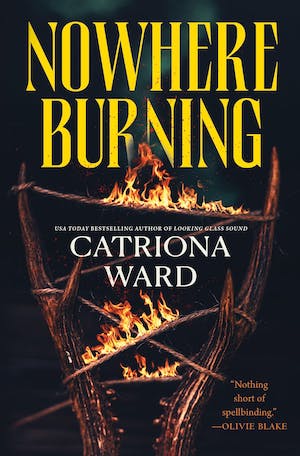
Nowhere Burning
Catriona Ward is an author who likes to mess with readers’ heads. I have referred to her as “The Mistress of Marvelous Misdirection” largely for her excellent use of unreliable narrators in previous novels (https://aheadfullofhorror.com/little-eve-by-catriona-ward/). With Nowhere Burning, Ward’s narrative is structured in a manner in which the trajectory of the plot bends and turns onto itself, a literary version of a mathematical non-orientable surface. It thus mirrors the topological Möbius strip that poetically symbolizes, among other things, a fluid connection between outer reality and an individual’s inner world. If that sounds intellectually burdensome, bear with me. The book’s unusual construction is certainly a stylistic element of note, and the novelty factor cannot be ignored. But it also allows the ever-clever Ward to manipulate perception: Perception of characters and their motivations, as well as a nebulous perception of time. Unexpected twists are threaded throughout, yet, in retrospect, the reader will see that hints were available in plain sight.
The plot centers on reactions to physical and psychological abuse: those who flee from it…and those who are drawn towards it. Nowhere is a compound inhabited by young people who fled abuse in their households. The abandoned estate is alluring due to being situated in a remote locale, and for legends about the property’s former owner who perished in a fire on the premises. He was a beloved movie star whose screen persona masked a dark side. The kids who live on the property survive by pilfering and on what the grounds of the former estate will yield. They also ritually feed the property in a sanguinary give and take. Runaway Riley and her young brother escape from the cruel cousin who served as their guardian, finding refuge among the other fugitives at Nowhere. Adolescent Riley is resourceful. She is a consummate survivor who knows that she must prove her worth to the denizens of the compound. Their rules and rituals are a cross between folk horror staples and, as pointed out in Nowhere Burning publicity blurbs, have a “Lord of the Flies” vibe. Riley realizes the potential for peril: “This is a dangerous place. It makes you forget things, like caution, and fear.”
For Adam, a former inhabitant of Nowhere, the environment is much more appealing. As an architect, he dwelled in the manse in its luxurious glory days: “It is a different world up here—a higher level of existence, like those medieval paintings of paradise, suspended in the clouds above all the regular dirty mortal business.” After the house burns in a fire, the estate is not so inviting: “The base of the gate is shored up with rocks and boulders so it can’t open inwards. It wears a shining crown of coils of rusting razor wire. Wicked shards of green glass gleam in spikes along the top, glued there somehow. On top there are the remains of animals. A gleaming green spike pierces the body of some bird, a blackbird perhaps. It has been impaled. There are others. A rat, a possum, a rabbit, a blue jay—dried-out remains. It’s a warning. This is what happens if you try to cross.”

There are abundant shifts in time throughout the narrative that reflect not only the history of Nowhere, but also the backstories of the characters. These temporal shifts are primarily identified by chapters demarcated by a character’s name. For example, a contemporary character named Marc is in a different timeframe than character Adam and both have chapter headings. This can initially make for confusing reading but, once the reader becomes accustomed to the unorthodox rhythm, it gets easier.
Nowhere House is itself a character in the novel: “The house seems to know. It plays with them. Again and again Nowhere House slides in and out of view, getting closer through the dark branches. It’s hard to throw off the impression that it’s coming to them, rather than the other way around.” The residence’s troubled history attracts those who find that sort of thing relatable. Does that make Nowhere House and its skeletal remains haunted? It depends on one’s definition of “haunted.” The character Marc surmises: “Other people’s memories are beginning to overlay reality. It happens when you get too deep into research. Staring at the past, the faces of the dead, makes them more real than the living.”
Embracing ambiguity like a dear friend, Catriona Ward pulls another rabbit out of the hat with Nowhere Burning, published by Nightfire. The novel’s complexity, both in structure and narrative, is challenging. Ward deals with appalling subject matter, presenting the fictional survivors of abuse as simultaneously poignant and calculating. Physical and emotional damage lead to poetic cynicism: “Love doesn’t die just because you stab it in the heart. It can walk around, wounded and bleeding, for years.” For all the intellectual intricacy of the book’s storyline and construction, the author never loses sight of that wounded and bleeding heart.
