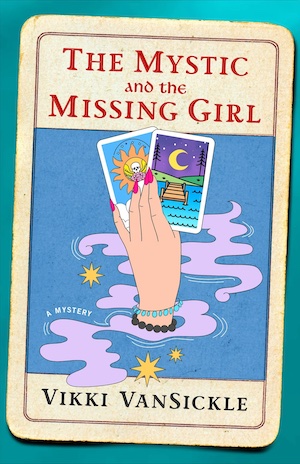
The Mystic and the Missing Girl
A cold case. A reluctant mystic who inherits her psychic aunt’s emporium. A reporter trying to write a breakthrough article. A town haunted by the disappearance of a high school girl that occurred twenty years ago. This is the literary witch’s brew concocted by novelist Vikki VanSickle. In The Mystic and the Missing Girl, VanSickle delivers an absorbing mystery with occult overtones. The engaging protagonist, Drew Benson, returns to her small Canadian hometown after the death of her beloved aunt who succumbed to cancer. The aunt had gained unwelcome notoriety two decades ago when she participated in the search for the missing girl. Drew, therefore, inherits not only her aunt’s property but also her stigma. The locals are planning a twenty-year anniversary tribute to the unfound teenager, making emotions run high in the community. Drew, who left her hometown of Stanfield for opportunities in Vancouver, is now in her thirties but discovers that some things have not changed in the interim she was away. The impact of the unsolved mystery created deep wounds and fissures that still linger.
In many ways, the novel follows the basic amateur detective formula and, for readers of that subgenre, that’s not a criticism. What makes it more interesting to those of us who are drawn to supernatural fiction is the psychic element and the metaphysical trappings. There’s quite a bit of time devoted to explaining the meaning of various tarot cards and how, when read in conjunction, the selected cards form a collective personal narrative. Yet, Drew has been hesitant of embracing her psychic talents and addressing the “glimmers” she sometimes gets from a place or an object. And bemoans the disappointment of her romantic relationships which are based more on impulse than intuition. Although, she is often sassily shrewd in her observations, as evidenced by this one regarding a love interest: “He wasn’t classically handsome—his appeal was more transgressive, with the dark magnetism and slightly rumpled look of a bass player in a nineties Brit-pop band.”
The book is peppered with pop culture references about the nineties and the aughts, retro appreciative and often aptly applicable to the storyline. Here’s one for fans of a cult TV series created by Mark Frost and David Lynch: “A middle-aged white woman in a waitress uniform that could pass as a Twin Peaks Halloween costume appeared with a pot of coffee that smelled burned.”

Author VanSickle has a knack for distilling characters through dress and demeanor. The figures who inhabit the novel are easy to picture/mentally access. What also impressed me is VanSickle’s verbal dexterity in enhancing images. Here’s an example: “Gruen’s Diner had the kind of deep kitsch city people dreamed about: wide booths with pleather seating that squeaked, green-and-white-tiled floors, and more chrome than a 1958 Buick. The restaurant was dim, each booth individually lit by a single sconce—a strategy that no doubt appealed to the early-morning crowd who shuffled in to get the breakfast special—$5.99 before nine—but also served a dual purpose of hiding old nicotine stains on the walls. It was so authentic it would be considered a themed restaurant anywhere else but Stanfield.”
There’s nice representation in The Mystic and the Missing Girl; the inclusion of racial portrayal and sexual orientations are casual and affable. The novel, published by Minotaur Books, has its own subdued kind of magic. Not horror per se, but with enough of an occult ambience to please readers of who enjoy quietly supernatural tales. Have a cup of herbal tea and a deck of tarot cards nearby while reading. And if a black cat is handy, that would be another mood enhancer.
