
Blanca: A Retro Review Tribute to Thomas Tessier
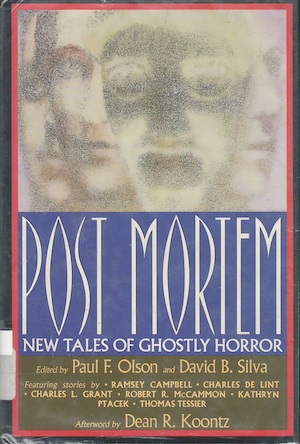
It was with great sorrow that I recently read horror author Thomas Tessier had died on March 26th, at age 78. Tessier was a rare writer, respected by those in the genre as well as critics outside of the horror community. His prose was seductive, often in the literal sense of the word, since he didn’t shy away from embracing eroticism. With his seminal work, The Nightwalker (1979), Tessier redefined the werewolf novel by bringing it into the modern age with its carnal canine uncanniness. The protagonist is bestially brutal and spellbinding. To honor Tessier’s memory, I have selected a short story that exemplifies the author’s ability to captivate. “Blanca” was first published in the 1989 anthology Post Mortem New Tales of Ghostly Horror published by St. Martin’s. It concerns a travel writer who chooses to decompress in a destination that he expects will be humdrum; a place where he can divest himself from journalism and simply chill. However, seeking insipidness in the region of Blanca proves to be far more challenging than expected.
First-person narration works extremely well in the story, since it is established that the protagonist is accustomed to expressing himself through his articles. As he sees the seedy side of Blanca, a region famous for raising cattle for meat, the travel writer’s observations kick in on a visceral level: “There were row houses right up to the open doors of an abattoir, apartment buildings wedged between a canning factory and a processing plant, and a vast maze of corrals holding thousands of cattle bumping against dozens of tiny backyards. After we cruised around for a while, I began to understand that these people literally lived in their workplaces: you would go home when your shift was finished, but home was hardly any different. The interminable stupid bawling of the cattle, the mingled stench of blood, raw meat, and cowshit, the constant rattling of trains, and the drumming vibrations of the factories—everything here, everything you saw or heard or felt or smelled was about decay and death. You could taste it in the air.” This disconnect from the pristine and mundane life in Blanca’s urban center is socially jarring, but it is the writer’s hotel room in town that creates a different kind of unease. There the protagonist has visions, the first being a seemingly a booze-induced dream, that are unnerving.
Looking down at the street from his room, he sees/imagines people of another era being forcibly carted away, apparently by law enforcement. In a later, more sober version of the vision, the people involved are contemporary. Is his mind doing socio-political extrapolation? A casual companion in Blanca suggests a supernatural explanation; the journalist is seeing ghosts. The writer, though, is aware that his anxiety about the prospect of turning 40 and the significant strain of his recent divorce could be factors: “Dreams, nightmares, hallucinations, ghosts. Take your pick. But maybe the simplest, truest explanation was that I was in the middle of a breakdown, caused by the collapse of my marriage and my abrupt flight to this miserable place. It made sense, and I hesitated, clinging to my own weakness.”
The worldly travel scribe, whose home base is New York, is losing his sense of self in what he believed would be an innocuous setting: “I sat down on the bed and lit a cigarette. My hands shook, my head clamored. The smoke was like ground glass in my throat, but I sucked it in deeply, as if trying to make a point with my own pain. I’d been so many miles, seen so much of the world, the best and the worst and the endless in between, but now for the first time in my life I felt lost.”
“Blanca” can be interpreted as a political parable. Or an anatomy of a meltdown. It could also be perceived as a tale about premonition and ghosts. Maybe all of those possibilities. No matter, what lingers is a rewardingly unsettling narrative that ends with the words “Look for me.” And with Thomas Tessier’s passing, I did again look for him. He remains with us through his uniquely memorable short fiction and highly regarded novels.

