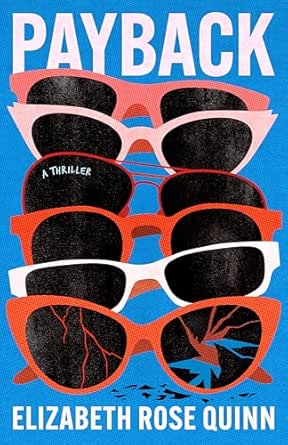
Payback
Making the decision to review Payback, after receiving a copy from a publicist, came with a question: Is this novel by Elizabeth Rose Quinn, applicable in subject for a horror fiction website? The book is published by Thomas & Mercer, a publishing house geared to the mystery and suspense genre. Payback indeed falls squarely into that category. There are nods to Agatha Christie, especially her renowned novel And Then There Were None, and one of the principal characters employs mentally manipulative machinations comparable to those of Hannibal Lecter. There are also major hat tips to the Knives Out series of films. After finishing Quinn’s narrative, I was left with another question regarding applicability: Does the novel’s delightfully daft plot and sardonic tone mute the author’s fundamental polemic about prison incarceration? Obviously, I have chosen to post a review and, in the course of writing it, came to a conclusion regarding the second question.
To accentuate the positives, the aforementioned Hannibal Lecter-like character is splendidly delineated. The reader sees his trajectory from churlish childhood into an adult with an appetite to cause psychological pain: “He was effervescent with malice.” Deciding that women are the superior gender for his brand of measured mental torture, he finds his ideal vocation as a correctional officer at a minimum-security prison in Los Angeles that primarily houses females who can financially finagle such a venue. The limited confinement at “Pay to Stay” consists of being on the premises from Friday through Monday and doing community service. However, even at a Club Fed penitentiary clone, the diabolical correctional officer exacts emotional payment: “He loved loosening the reins until the women relaxed and then giving a sharp yank, reminding them of the bits in their mouths and the rider controlling their every movement.”

The six women in custody are mixed in age, status, backgrounds, and professions. Some are not particularly relatable, and/or are extreme stereotypes. There is a delicate balance in achieving satisfying satire, and not everything that gets thrown against a wall sticks. In this narrative, there’s a hit or miss success ratio that tilts in the direction of hit, due to the author’s penchant for smart snark. In addition to the female inmates, there’s a male prisoner who is in the process of being transferred to another facility. One of the people in this group is a serial killer, and each have a reason to commit murder. Following the classic locked room mystery paradigm, all of the suspects have something to hide and are, at the very least, morally guilty in some way.
Much of the best prose in the book has do with the setting. The descriptions of Los Angeles are wonderfully written, as this passage confirms: “Even on an aesthetic level, the city existed in extremes. The manufactured kitsch of Hollywood Boulevard, studio back lots housing spaceships on fake oceans, and plastic surgery faces plumped to a supernatural sheen in the grocery store line were all unremarkable here. A total buy-in from everyone on the land of make believe. Yet natural beauty also thrived in this sprawling city, wild and free. The screaming magenta of bougainvillea that draped over entire buildings. The scent of night-blooming jasmine cradling tranquil canyon trails, where coyotes roamed freely.” In the following paragraph, there’s this equally evocative city summation: “A place for immigrants and citizens alike to reinvent themselves. A place that cherished ease, encouraged strange dreams, and welcomed everyone who was too weird for their place of birth.”
Returning to the two questions I discussed at the opening of this review, in general, I enjoyed Payback even though the novel doesn’t neatly fit into the genre niche of this website. Elizabeth Rose Quinn’s writing has a zaniness that makes the unbelievable aspects of the storyline literarily acceptable, if not credible. Which leads me to the second question I mentioned. After the narrative ends, there’s an author’s note that includes this sentiment: “Incarceration, as we have construed it in America, is a harmful practice that does nothing to rehabilitate people, make victims whole, or prevent future crime. In fact, statistically it fails on all three of those goals. I wonder if part of the inertia in correcting the problem is that we cannot repair a system that is so deeply broken by design. We must start over from scratch.” The seriousness of those words illustrates the author’s depth of feeling. Yet the social comment in the Payback storyline is much lighter, not so deep. Harkening back to my reference concerning the possible influence the Knives Out series of movies had on this novel, those films delivered social commentary and ironic humor sans subtlety…but without overt verbal messaging statements. Since it is likely that Payback was written with a film or television adaptation in mind, one may assume that any passionate and committed points of view will be dispersed through dialogue and visuals in adaptation; no coda tacked on at the end yanking the audience out of the realm of loopy fiction. This structural appraisal aside, Elizabeth Rose Quinn’s intentional return to somber reality in her author’s note is clearly commendable for its candor and doesn’t detract from appreciating Payback as an entertaining mystery romp.

