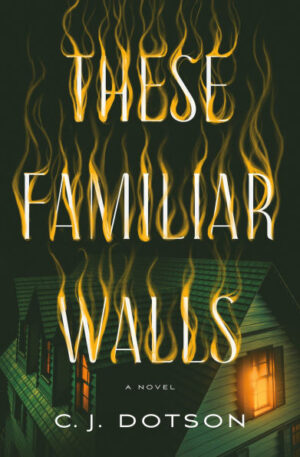
These Familiar Walls
These Familiar Walls by C.J. Dotson is a horror novel that posits an interesting question: Does aberrant behavior in adolescence signal a mental health warning in adulthood? Of course, the term “aberrant” is subject to interpretation. And, as author Dotson splendidly points out, juvenility is difficult even for those who are very grounded. In the case of protagonist Amber, who was an insolent preteen in 1998, navigating those years left scars. Embittered and distrusting, the adult Amber in 2020 now must cope with the Covid pandemic while moving back into her parents’ house, which she inherited after they were brutally murdered. Joining her for the transition are her fireman husband and two young children. A recipe for stress with a potential for disaster, Amber’s return to the home which shaped her youth is fertile territory for figurative and literal ghosts to haunt.
The story unfolds in two timelines: 2020 and 1998, with a brief sojourn into the period when Facebook was the rage, circa 2006. The 2020 segments depict a disdainful Amber, who brandishes her contemptuousness: “She used the hatred like a blanket, spread it over everything else, smothered the flicker of concern.” Even when encountering possible phantoms, Amber relies on a rancorous demeanor: “Never show the fear. One certainty, rock solid and unquestionable drove her—to show fear, to present anything other than the right face, would bring down calamity on them. On her.” While this cloak of courageousness may seem impenetrable, certain interactions do give her a jolt: “The whispers began, drifting from the thing that shuffled nearer to her. The lips did not move, the tongue lay flat and dead within the reeking cavern of the mouth, but the whispers came nevertheless. Hate-filled. Hissing. Indistinct, until eyes like smoldering coals met Amber’s and the whispers filled with her name.”

Writer Dotson’s sly literary bag of tricks includes applying one of horror fiction’s most reliable furnishings, the mirror. Amber’s reflection in mirrors and glass is distorted and disfigured. She demands her husband cover them, but as in the film The Others (2001) in which exposure to light posed a danger, we all know that taking rational steps cannot defeat what defies rationality: “Fingertips first, a pair of hands reached around from the back of the reflection’s head. The hands closed over that eyeless face at the same time as the rotting breath washed over the back of her neck and filled her nose with the smell of death.”
While the spectral hits just keep on coming for Amber in 2020, it is the 1998 chapters of the book that I found most accessible and intriguing. Young Amber is surly and often difficult to like, but she is comprehensible. An outsider, while her younger sister is socially gifted, she is resentful. When she forms an alliance with a sadistic boy neighbor, an unholy kinship transpires. He pays attention to her, and she is flattered. Then, he abuses her trust in him. And the normally distrustful Amber gets even. It soon becomes evident that both young people will carry the proverbial chips on their shoulders into adulthood, and any perceived threat would be addressed with retribution. Amber’s mindset was established during that time and then carried it with her into the future: “No one put her fucking last in line.”
These Familiar Walls, published by St. Martin’s, is a savvy and scary cornucopia of genre frights, punched up by C.J. Dotson’s driving prose. The novel is unrelenting in its unearthing of the dismal aspects of adolescence, while structurally catering to the currently popular denouement twist. It is a haunted house tale that will surely generate discussion.

